You Don’t Have to Choose Between Logic and Creativity
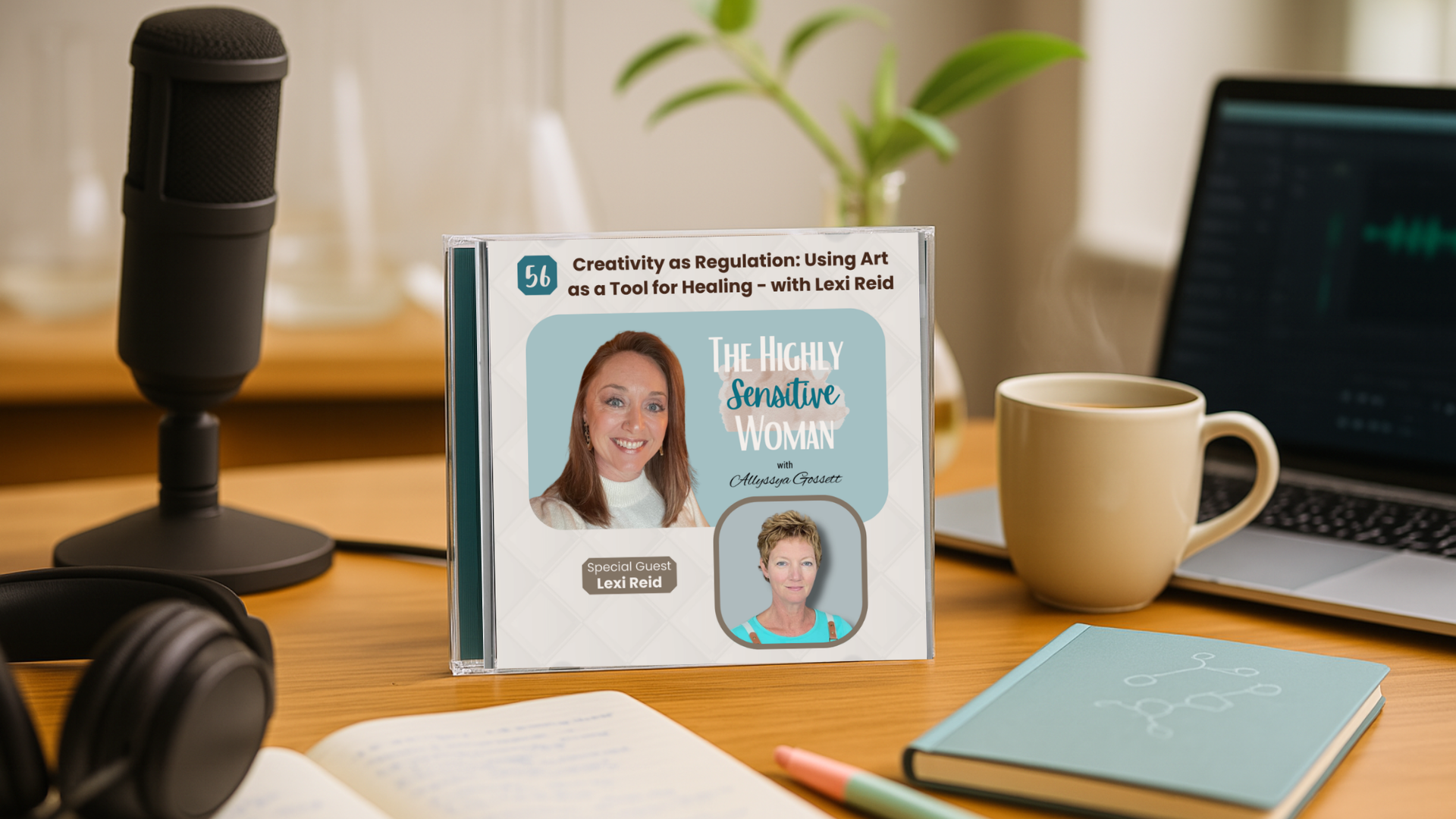
I recently joined Allyssya Gossett on The Highly Sensitive Woman podcast for a conversation that felt very close to home.
We talked about something I see come up again and again with the women I work with.
The feeling that you have to choose.
Between being logical or creative.
Between being successful or feeling like yourself.
Between doing what makes sense and doing what actually feels good.
And if you’ve ever felt that tension, you’re not alone.
In this conversation, we explored what it looks like to move from that “either/or” way of thinking back into something that feels more whole. We talked about burnout, nervous system regulation, and how creativity can be a simple, practical way to come back to yourself.
If you’d like to watch on YouTube or listen to the full episode, you can find it here.
When “And” Turns Into “Or”
One of the first things we talked about was how natural it is, especially as a kid, to be both.
You can be curious and imaginative.
You can love science and art.
You can experiment in the kitchen and then go draw or paint.
That “and” feels easy when you’re younger.
But somewhere along the way, it often turns into an “or.”
For me, that shift happened when I was choosing a career path. I was encouraged to pursue science because it felt more stable, more practical. And that made sense at the time.
So I followed that path.
I went into biology, then plant science, then into a PhD working with plant microbiology and genetically modified organisms. I was even working on developing a cholesterol-lowering compound in canola plants, which was fascinating.
I loved the work.
But I also quietly let art fall away.
What Happens When You Leave Part of Yourself Behind
At the time, it felt like a reasonable trade.
I told myself I could always come back to art later. That it was something I could do on the side.
But over time, I started to notice something was missing.
Not in a dramatic way. Just a subtle sense that something important had been set aside.
It wasn’t until I had my kids that I started finding my way back.
I’d buy art supplies “for them,” but really, I was buying them for me. I’d sit with them and create, and something started to come back online.
Not perfectly. Not consistently.
But enough to notice the difference.
When Burnout Blocks Even the Things You Love
Then COVID hit.
And everything intensified.
At the time, I was working in medical device quality and regulatory affairs, and our company was part of a major effort to develop emergency ventilators. The pressure was high, the timelines were tight, and the work felt urgent.
I was working constantly.
At the same time, my kids were home, navigating school from the kitchen table.
And eventually, I burned out.
The part that surprised me most was this.
I couldn’t create anymore.
I’d walk into my studio and feel completely blocked. Not uninspired. Just… nothing. Like that part of me had shut down.
If you’ve ever felt that you know how unsettling it is.
The Shift That Made It Easier to Come Back
What helped wasn’t going back to making “real art.”
It was letting that go completely.
Instead of trying to produce something good, I started doing very simple things.
Drawing lines in time with my breath.
Making repetitive shapes.
Using whatever markers my kids had lying around.
No pressure. No expectation.
And that changed everything.
Because what I realized is that creativity doesn’t have to be about making something to show.
It can just be about how it feels while you’re doing it.
Why Simple Creative Practices Work
When you’re overwhelmed, your system is often in a constant state of activation.
You’re thinking, planning, reacting, solving.
And it’s hard to switch that off.
What these simple creative practices do is give your body a different kind of input.
You’re moving your hand.
You’re focusing on colour or shape.
You’re engaging your senses.
And without forcing it, your breathing starts to slow.
Your body starts to settle.
You move out of that constant “on” state and into something a bit more grounded.
What You Can Learn From a Simple Drawing
One of the exercises I shared in the conversation is a body scan drawing.
You draw a simple outline of a body and use colours or shapes to show where you’re feeling stress.
It’s interesting because most women can identify their stress right away.
Tension in the shoulders.
Pressure in the head.
That tight feeling in the chest or stomach.
But when I ask where they feel grounded or calm, it takes longer.
That alone can be revealing.
Another exercise is drawing a bridge between where you are now and where you want to be.
And what shows up on that page can be surprisingly honest.
Some women draw stormy skies on one side and peaceful landscapes on the other.
Many draw bridges that are unstable, with missing planks or obstacles underneath.
Even though they could draw anything, they often make the path harder for themselves.
It becomes a visual way of seeing patterns that are already there.
Starting Without Making It Complicated
One thing that came up in the conversation is how easy it is to overthink this.
What supplies do I need?
Do I need a proper sketchbook?
What if I’m not good at this?
And the answer is, you don’t need anything special.
A piece of paper is fine.
A pen is fine.
Markers, if you have them.
That’s it.
In fact, keeping it simple helps.
Because it removes that extra layer of pressure.
You’re not trying to create something impressive. You’re just giving yourself a small moment to pause.
A Few Simple Ways to Begin
If you’re not sure where to start, here are a few easy options.
Draw lines in time with your breath for a few minutes.
Put on music you like and let your hand move with the rhythm.
Make a quick scribble and see what shapes or images you notice.
None of these need to turn into anything.
They’re just a way in.
If You’ve Been Feeling Disconnected
If you’ve been feeling overwhelmed, overstimulated, or just not quite like yourself, this kind of work can be a gentle place to start.
Not because it fixes everything.
But because it helps you reconnect.
And for many highly sensitive women, that reconnection is what’s been missing.
It’s not about becoming more productive.
It’s not about doing it perfectly.
It’s about giving yourself a few minutes to come back into your body and notice what’s there.
If This Conversation Resonates
If this feels familiar, you might want to try a few of these practices for yourself.
You can start with the 5-Day Creative Reset Challenge, where I share short, simple exercises you can do in just a few minutes a day.
Or you can join The Creative Shift, my weekly newsletter with practical tools and reflections around creativity, stress, and wellbeing.
Because you don’t have to choose between being logical and being creative.
You can be both.
And sometimes, reconnecting with that part of yourself is exactly what helps everything else feel a little more manageable again.