Motherhood, Burnout and Finding Your Way Back to Yourself
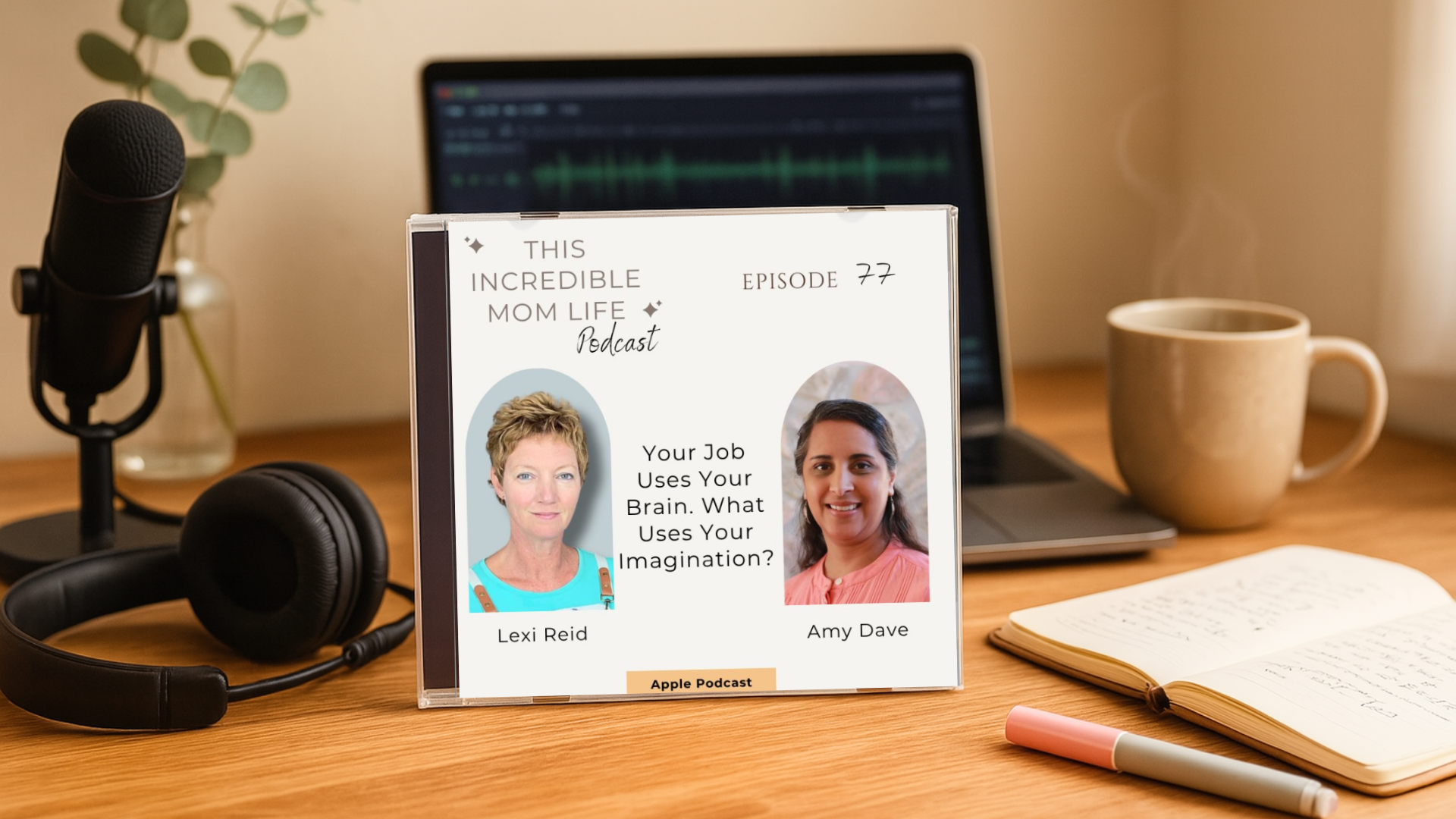
I recently joined This Incredible Mom Life podcast with Amy Dave for a conversation that started with motherhood and quickly moved into something many women know well: what happens when work, family, caregiving, hormones, and the mental load all pile up at once.
We talked about my experience of burnout during the pandemic, why women can find it so difficult to say no, and how simple creative practices can create a little breathing room when everything feels like too much.
But before any of that, we swapped mom stories.
Mine involved a four-month-old baby, a very posh shop on Bloor Street in Toronto, an explosive diaper, and some extraordinarily expensive imported baby wipes.
Motherhood has a way of keeping you humble.
Sometimes the Best Parenting Lesson Is "Pack More Wipes"
My daughter is 19 now, and I'm sure she'd be horrified to know I told this story publicly.
But here we are.
When she was about four months old, I was visiting Toronto and spending the day shopping with a friend. I didn't want to lug around a stroller and giant diaper bag, so I had my daughter strapped to me in a BabyBjörn and packed what I thought was enough.
One more diaper.
A few wipes.
Good enough.
Except we'd already gone through two outfits that morning.
Then, while standing inside an extremely upscale baby store, I saw that unmistakable look of concentration cross her face.
Any parent knows the look.
What followed was spectacular.
Her diaper couldn't contain it. Her little summer onesie couldn't contain it. The BabyBjörn certainly couldn't contain it.
Neither could I.
My friend started grabbing wipes off the shelf while I attempted damage control. We tried to put everything into a Diaper Genie before realizing it was a display model with no bag inside.
By that point, everyone in the store knew exactly what was happening.
Eventually we got both of us cleaned up and I went to pay for the wipes we'd used.
They were imported from France.
Twenty-three dollars a package.
And we'd used two.
My friend thought this was hilarious.
I was slightly less amused.
The lesson?
Sometimes being a little overprepared is worth it because, quite literally, poop happens.
My Career Changed After Becoming a Mom
Motherhood also played a much bigger role in my career than I realized at the time.
My background is in science. I followed the traditional academic route through a bachelor's degree, master's degree, PhD, and postdoctoral research.
I had my daughter while I was doing my postdoc.
When I returned from maternity leave, something had shifted.
I didn't love laboratory work anymore.
Research can have a schedule of its own. Experiments don't necessarily care that you have daycare pickup or a baby who was awake half the night. I found myself questioning whether I wanted to keep juggling that kind of work with family life.
So I started looking around.
That decision eventually took me from academic research into a not-for-profit organization, then into the federal government, business development, and eventually quality and regulatory work in medical devices.
My career didn't follow the path I'd imagined when I started university.
I'm glad it didn't.
Then Work Moved Into My Bedroom
Years later, the pandemic changed the equation again.
My son had just started high school. My daughter was in middle school.
Like so many families, we were suddenly trying to work, learn, live, and stay sane inside the same house.
My desk was in my bedroom.
There was literally no separation between where I worked and where I slept.
At the same time, the medical device company I worked for had received a major government contract to develop emergency ventilators.
This was before vaccines were readily available. There was an enormous sense of urgency surrounding the project.
So we worked.
And worked.
And worked some more.
I kept thinking I could answer the next email.
Review the next document.
Handle the next deadline.
Until eventually I couldn't.
For Me, Burnout Lost All the Colour
I didn't recognize burnout when it was happening.
At first, I became numb.
Nothing seemed particularly funny or joyful anymore.
Then I swung in the other direction.
Everything irritated me.
I snapped at my husband.
I snapped at my kids.
I snapped at colleagues.
That was very unlike me, but even then, I kept moving.
The other warning sign was my studio.
I'd always used art as a way to decompress. But suddenly I'd walk into the room, stare at my supplies, and feel nothing.
I couldn't paint.
I couldn't make a collage.
I couldn't even decide where to begin.
Everything felt grey.
Why Women End Up Carrying So Much
During the podcast, we talked about why burnout can be so common among women.
There isn't one answer.
But caregiving came up again and again.
Many women are caring for children while also beginning to support aging parents. My generation is often called the sandwich generation for exactly that reason.
Then add work.
Household responsibilities.
Appointments.
School schedules.
Networking.
Family gatherings.
The invisible little tasks that somebody has to remember.
Often that somebody is you.
And somewhere in there, you stop asking whether you actually want to keep saying yes.
You simply do it because you're used to being the person who keeps everything moving.
That's why boundaries are such an important part of the work I do with women in STEM*.
Before we even talk about creativity, we often need to talk about permission.
Permission to pause.
Permission to ask for help.
Permission to say no.
*Science, Technology, Engineering, and Mathematics.
Step Away Before You Solve Anything
Not every stress-management tool needs to be complicated.
Sometimes I go for a walk.
Five minutes around the block can be enough to interrupt whatever loop my brain has fallen into.
Nature is even better for me.
A park.
A tree.
Somewhere I can physically step away from the thing that's consuming my attention.
I think we sometimes underestimate the value of changing the scenery.
You don't necessarily need to solve the entire problem during that walk.
You're simply creating enough distance to come back to it differently.
Why Are We Always Drawing the Hardest Bridge?
One of the creative exercises I shared on the podcast is called The Bridge.
You draw where you are now on one side of the page.
That side might contain the things weighing you down, the challenges you're facing, or the baggage you're carrying.
On the opposite side, you draw what you'd like life to look like.
Then you connect the two with a bridge.
I don't tell people what kind of bridge to draw.
That's important.
And yet so many women create these terrifying little structures.
Missing planks.
Frayed ropes.
Raging water underneath.
One woman drew a troll under hers.
Then she looked at it and realized she was the troll.
She was the one holding herself back.
What fascinates me is that nobody asked them to make the journey difficult.
They could have drawn a beautiful suspension bridge.
A drawbridge.
The Golden Gate Bridge.
Something solid.
Instead, they often unconsciously make the crossing as difficult as possible.
There's usually something worth exploring there.
Midlife Can Turn the Volume Up
We also talked about perimenopause.
This part of the conversation was much more personal.
I'm in my early 50s, and I've noticed how quickly my emotions can shift.
One minute I'm fine.
The next I could cry.
Or rage.
Sometimes it reminds me uncomfortably of being a teenager again.
I've talked about it with one of my best friends from high school, someone I've known since our swim-team days, and she's experiencing many of the same things.
For me, sleep disruption makes everything harder. When I don't sleep well, I notice the brain fog and my patience disappearing much faster.
So I'm trying to pay closer attention.
More walks.
More breathing.
More recognition that sometimes I need to adjust what I'm asking of myself that day.
I don't always get it right.
But noticing what's happening is better than pretending nothing has changed.
Start With the Crayola Markers
One thing I don't do is hand someone an expensive box of art supplies and tell them to become creative.
We start smaller.
Computer paper.
A pen.
A pencil.
That's enough.
Then something funny happens.
Women start asking if they can use colour.
Of course.
Suddenly they're digging through their desk for highlighters.
Borrowing markers from their kids.
Adding colour because they want to, not because I instructed them to.
That's the moment I love.
It's a small sign that permission is beginning to replace perfectionism.
Your Symbols Only Need to Make Sense to You
Visual language is incredibly personal.
I often use the example of a red balloon.
Picture one.
What came to mind?
Maybe you thought of the Banksy image of the little girl reaching toward a red balloon.
Or perhaps you've seen Stephen King's It and immediately pictured something far less comforting.
Same object.
Completely different emotional meaning.
That's why I don't interpret someone's drawing for them.
The symbols belong to the person making them.
Your dark cloud might mean sadness.
Mine might mean a favourite rainy afternoon.
That's what makes drawing such an interesting form of reflection.
You create your own shorthand.
A Drawing Can Become a Time Capsule
I do follow-up conversations with women months after they've completed coaching.
Sometimes even a year later.
They'll pull out drawings they made during the program and immediately remember how they were feeling at the time.
It's a bit like opening an old journal.
Except there's something incredibly immediate about seeing the symbols.
You remember the stuck feeling.
The uncertainty.
The thing that seemed enormous at the time.
Then you look at your life now.
Sometimes the problem is gone.
Sometimes it has changed.
Sometimes you have changed.
That's one of the reasons I like creative reflection so much.
The page keeps a snapshot of a moment you might otherwise forget.
Maybe You Need Permission to Play
One phrase from the conversation stayed with me:
Permission to play.
Adults aren't always very good at this.
Especially high-achieving adults.
We want the activity to have a purpose.
We want to be good at it.
We want a measurable outcome.
A finished product would be nice too.
But play works differently.
You doodle because it feels good.
You add colour because you want to.
You make something that doesn't need to be useful.
And perhaps, for five or ten minutes, you stop being the employee, the mother, the daughter, the partner, the organizer, or the person everyone calls when something needs to be handled.
You're simply making something.
That's enough.
What Would Five Minutes Look Like for You?
If you're feeling stretched thin, don't begin by promising yourself an entire afternoon of self-care.
Try five minutes.
Go around the block.
Sit outside.
Pick up a pen.
Draw the bridge between where you are and where you'd like to be.
Scribble the mood you're carrying today.
Steal a few of your kids' Crayolas.
See what appears.
You don't have to call yourself creative.
You don't have to show anyone what you make.
And you certainly don't need another thing to be good at.
You just need somewhere to begin.
If you'd like some guidance, my free 5-Day Creative Reset Challenge gives you a simple creative prompt each day so you can experience this approach for yourself. It's designed as a gentle introduction, not another task you have to complete perfectly.
You can also subscribe to The Creative Shift, my weekly newsletter, where I share creative exercises, reflections, and practical ideas for managing stress and reconnecting with yourself.
Because caring for yourself doesn't mean stepping away from the people you love.
Sometimes it means making sure there's still a little room left for you, too.