How Creativity Helped Me Recover from Burnout
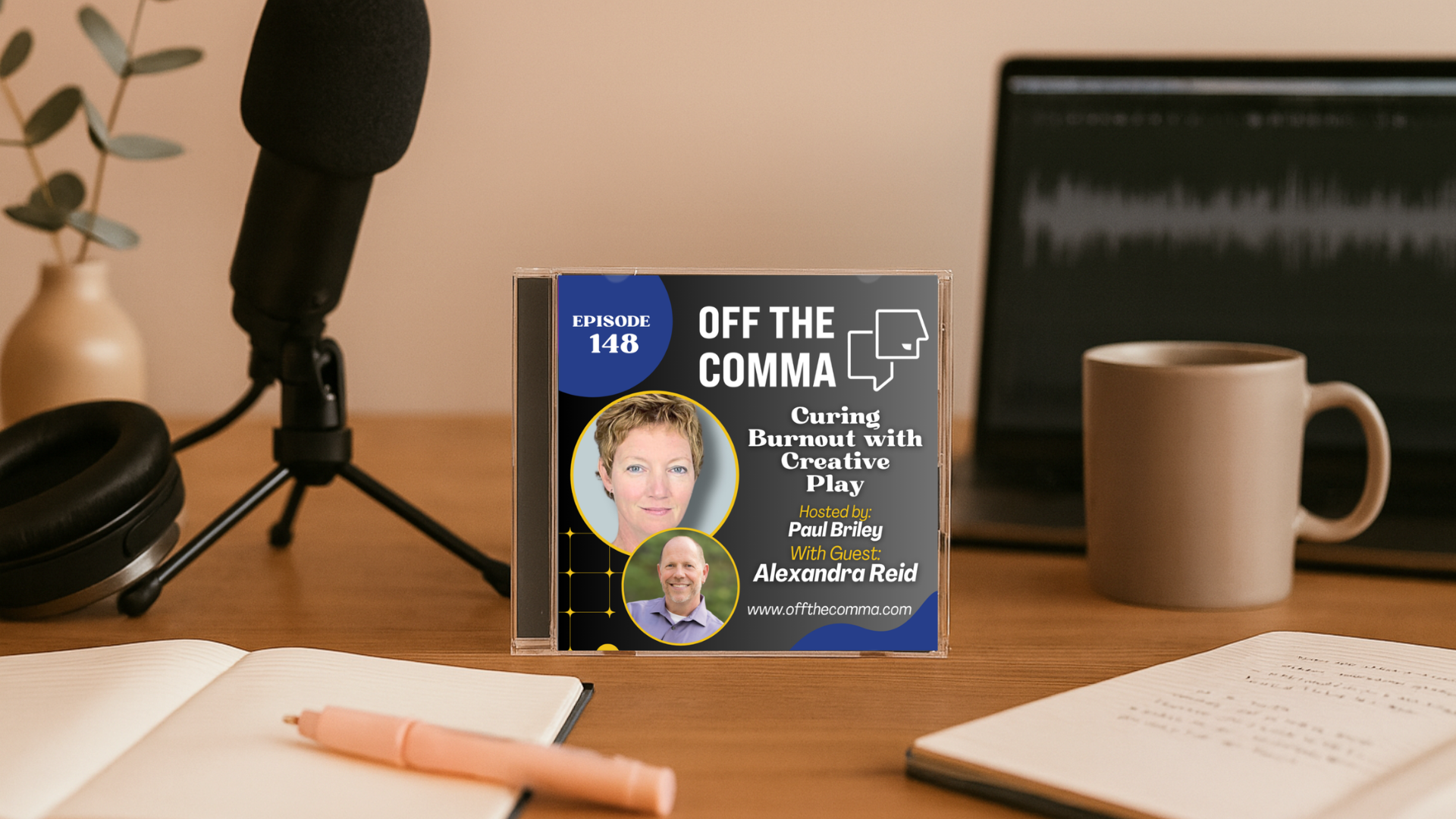
I recently had the pleasure of joining Paul Briley on the Off the Comma podcast, and our conversation felt a little different from many of the interviews I've done.
Instead of focusing only on burnout or creativity, we explored the moments in life that interrupt the path we thought we were on. The moments that make us stop, reflect, and eventually choose a different direction.
Paul calls these moments "the comma."
I love that image.
A comma isn't the end of the sentence.
It's simply a pause before the story continues.
If you'd like to listen to the full conversation, you can find it below:
My Career Was Never Just One Thing
When Paul asked me to introduce myself, I realized I usually describe myself using three words.
Scientist.
Artist.
Coach.
Those three parts of me now work together, but they certainly didn't arrive at the same time.
For a long time, I thought I had to choose.
I followed the academic route through biology, earning my bachelor's degree, master's degree, PhD, and completing a postdoctoral fellowship. Art quietly moved into the background while I focused on building a scientific career.
It wasn't until years later, after raising children and returning to a studio full of untouched art supplies, that I realised creativity hadn't disappeared.
It had simply been waiting.
Science Never Replaced Creativity
People often assume science and art live on opposite sides of the brain.
I've never experienced them that way.
During my research career I spent countless hours using confocal laser scanning microscopy, watching fluorescent proteins move through living cells. Those microscopic images were stunning.
Looking back, I think they satisfied the same part of me that loved drawing and painting.
I just hadn't recognized it at the time.
Even now, nature remains one of my biggest creative influences.
Living on Vancouver Island, I'm constantly surrounded by forests, mountains, and the ocean. Those landscapes continue to remind me that creativity isn't something separate from everyday life.
It's woven into it.
When Work Took Over Everything
Eventually, my career led me into quality and regulatory work within the medical device industry.
Then the pandemic arrived.
Our company secured a major government contract to help develop emergency ventilators. The work was incredibly meaningful, but it was also relentless.
Like so many people, I was suddenly working from home while helping my children navigate remote school.
My desk ended up in my bedroom.
That detail might sound small, but it mattered.
There was no clear boundary between work and rest anymore.
Emails were always within reach.
My mind never really switched off.
Burnout Didn't Arrive All at Once
One of the things we talked about on the podcast is how deceptive burnout can be.
It doesn't usually show up overnight.
It builds slowly.
First I became impatient.
Then I became exhausted.
Eventually I stopped feeling much of anything.
Everything just felt... grey.
The biggest warning sign came when I walked into my art studio and couldn't create.
For someone who had always found energy through creativity, that silence felt louder than anything else.
Looking back, I can see what was happening.
At the time, I couldn't.
The Smallest Drawing Made the Biggest Difference
Ironically, the turning point happened during another Zoom meeting.
While listening, I absentmindedly began doodling.
Nothing elaborate.
Just simple shapes.
As I drew, I noticed something unexpected.
My breathing slowed.
My shoulders relaxed.
When the meeting ended, I actually felt better.
Being a scientist, my first instinct wasn't simply to enjoy the moment.
It was curiosity.
Why had that worked?
That question eventually led me to study creativity, coaching, art therapy, and the science behind stress regulation.
Why I Chose a Different Direction
People often ask about the difference between therapy and coaching.
During the interview I shared an analogy from my years as both a competitive swimmer and a lifeguard.
If someone is struggling to stay afloat, they need immediate help getting safely to the side of the pool.
That's how I think about therapy.
Coaching is different.
It's helping someone who already knows how to swim refine their stroke, improve their breathing, and move through the water more efficiently.
Both are valuable.
They simply serve different purposes.
My work focuses on helping women build habits, awareness, and creative tools before stress becomes burnout.
The Pressure to Produce
One realization surprised me.
Even as an artist, I had accidentally made creativity another performance.
If I was going to spend time in my studio, I believed I had to create something "worthy."
A finished painting.
A polished piece.
Something impressive.
That mindset made creativity feel like work.
Today I encourage something very different.
Play.
If you can draw a stick figure, play Pictionary, or sketch a few symbols on a page, you're creative enough to begin.
Those simple drawings often reveal far more than polished artwork ever could.
A Page Can Hold More Than Words
One reason I continue using drawing in coaching is that it gives people another language.
Sometimes a simple symbol communicates something that's difficult to explain verbally.
A scribble can express frustration.
A colour can capture emotion.
A tiny sketch can become a snapshot of where you are today.
Months later, clients often tell me they look back at those drawings and notice something entirely different.
The page hasn't changed.
They have.
That's one of my favourite parts of this work.
A drawing grows alongside you.
Recovery Isn't a Finish Line
Paul asked an important question near the end of our conversation.
How do you know when you've recovered from burnout?
My answer was probably not what people expect.
I don't think recovery is something you permanently complete.
It's more like recovering from a back injury.
Once you've experienced it, you become much more aware of the habits that can aggravate it again.
For me, those habits include answering one more email, staying up a little later, or believing I can push through one more busy week.
The difference now is that I notice those patterns much sooner.
Awareness gives me the chance to choose differently.
Let Yourself Play Again
One of the biggest lessons I took from my own experience was learning to remove the pressure.
I no longer walk into my studio expecting every creative session to produce something remarkable.
Sometimes I simply paint sheets of paper.
Sometimes I make collage materials I'll never use.
Sometimes I experiment with colour just because it's enjoyable.
None of it is wasted.
Play isn't the opposite of productivity.
Sometimes it's exactly what allows meaningful work to happen later.
If This Conversation Resonated
If you've been feeling stretched thin, disconnected from yourself, or convinced you don't have a creative bone in your body, I'd encourage you to start much smaller than you think.
Draw a few lines.
Sketch a symbol.
Play for five minutes without worrying about the outcome.
You might be surprised by what that simple pause reveals.
If you'd like some guidance, you can join my 5-Day Creative Reset Challenge, where I'll walk you through simple creative exercises designed to reduce stress and help you reconnect with yourself.
You can also subscribe to The Creative Shift, my weekly newsletter where I share practical ideas, reflections, and creative wellness tools for women navigating demanding careers.
Because sometimes the comma isn't an interruption.
It's the place where the next chapter quietly begins.